Social networking sites like MySpace, FaceBook, and even Twitter, can be great places to promote your website or blog.
Start by creating a group or groups, centered around your niche market and begin networking with other users who have the same interest in your niche topic.
FaceBook allows you to create a business or “fan” page that can be used to share and post information to promote your business website.
You can use your fan page to share information such as your hours of operation, location, etc. It can function as a marketing tool that can generate leads for and promote your business.
Twitter’s founders don’t actually classify their web site as a social networking site, but anyone using Twitter can tell you in a hurry that it definitely falls into that category.
Twitter is actually more like a micro blog; and although many people consider Twitter and Tweeting to be a total waste of time, if you learn how to use it properly, it can be a valuable sales asset and traffic generating business tool.
Just like anything else, social networking sites can be great promotion tools. But to get the best results, you need to learn how to use them effectively.
It will require a bit of testing and experimentation on your part to determine what works best for you. But when you DO get the right formula; you’ll be glad you “wasted your time” playing around with social networking sites.
We realize that social networking sites aren’t for everyone and that they’re not absolutely necessary to run a successful website or blog, but using them to promote your web sites can definitely make your life run a lot smoother.

It’s important to understand the benefits of Twittering, and that Twitter can be used for much more than just personal updates.
With the introduction of microblogging to the Internet, Twitter has reduced the time it takes to market content from hours, that it used to take from using previous forms of communication; to minutes and even seconds, through the use of Twitter Tweets.
Although many users like to put in cat updates, or tell everyone what they’re doing in the bathroom at 2:00 in the morning; Twitter has many more useful purposes than that.
Initially blogs used to have the same stigma attached to them; but with microblogging, the world suddenly woke up and almost immedately understood what the power of simple publishing, combined with citizen journalism could accomplish.
Twitter is a place where you can freely accomplish many things.
The benefits of Twittering allow you to:
- Promote yourself
- Promote your business
- Promote others (affiliates)
- Get advise on almost anything
- Run polls to find a consensus
- Acquire human resources
- Immediately broadcast important breaking news
- Socialize
- And the list goes on ….
Microblogging has become so widespread, that if you participate in any social media community these days; people probably already know that you’re also on Twitter.
While Twitter doesn’t in itself have the best methods of finding people; you can always Twitter to see who your friends are following, or just join the conversation without being too intrusive, and simply ask.
Don’t be bashful, join in and make your presence known.
When you get involved with the community, jump in and share your expertise. See what people are talking about, ask questions and give good answers when you have them.
Know the difference between pushing and pulling. For instance, when you post a link to your latest blog post to Twitter, you are making a push, or an action to grab the reader. Direct marketers have mastered the technique of pushing and have developed it into an art form.
Although some of your readers can ignore your posts; the people that appreciate your posts will immediately check you out.
On the other hand, RSS is a pull. Users generally check RSS at their own speed, and it usually takes much more time to get any “buzz” going around your content.
Read the Tweets that are already out there.
One of the benefits of Twittering is that there’s a lot of valuable information from a lot of smart individuals on Twitter, that you can use for yourself and your business, if you just take the time.
This is how to get automatic Tweets on your Twitter page, when you get too busy or overwhelmed to do it yourself.
 Twitter Feed, is a simple free tool you can use to pull in RSS feeds from your blogs, article sites, or any other site that has an RSS feed you want to hook up with.
You can use Twitter Feed with only your own blogs, or in conjunction with your friend’s blogs and other quality sites that you would like to use to update your blog.
This works great for people who are often too busy to post to their own blogs on a regular basis.
First do a Google search for Twitter Feed, go to their website, and sign up for your free account by providing your email address and creating your password.
- You will then be directed to the second step where you create your feed for your blog.
Here is where you name your feed, and insert the RSS feed URL for your website.
The URL of your feed will depend on which blogging platform is used, but you can usually find it by clicking on a button or icon labeled “RSS”, “Atom”, “Syndicate”, or something similar or by clicking on the icon located in the right hand side of your browser address bar.
If you still have trouble finding it, you can always check the documentation of the blogging platform software that you are using. This should tell you how to find the feed URL.
You can click on the advanced settings to further customize how you want your feed sent.
- Next you move to step two where you configure your publishing services.
Here you can get automatic Tweets on your Twitter page, Laconia, Ping.fm, Hellotxt, or Facebook by just clicking on each service and either joining, or activating and authenticating your existing subscription.
That’s all the work you need to do to finish your feed and to get automatic Tweets on your Twitter page.
You can create all the additional feeds you like by signing into your dashboard and following the above procedure.
This is probably one of the easiest ways to get automatic Tweets on your Twitter page, Facebook, and your other publishing services.
You know that Twitter is good for business, when both Google, and Bing, begin to index Tweets in the search engine results.
Although we’re not sure how they are going to accomplish it; last week, both Google and Bing, made their announcements to that effect.
If you need to be convinced that Twitter is good for business, just go to some of the “big boys” websites to confirm my opinion.
Twitter has been steadily growing in importance, attracting more and more followers every day.
Since so many consumers are now using social media sites like Twitter, more and more savvy internet marketers have noticed that online merchants, are also testing the waters, and experimenting with Twitter.
To date, most merchants still do not seem to be paying much attention to Twitter, or to the other social media sites; however, with Google and Bing’s announcement, things are about to change!
If you’re not currently on a social website like Twitter, your competition may already be out gunning you.
You should consider using Twitter to promote your brand, increase your visibility, and maximize your earnings.
 It’s obvious that Twitter is good for business, when e commerce merchants like Amazon, Sears, and Walmart, start using accounts dedicated to Twitter.
This should tell you something.
Some merchants like Amazon, use multiple accounts to manage different sectors of their business, while others like Sears, use only one interactive account.
If you decide to experiment with Twitter, it’s important for you to explain to your customers, exactly how you operate.
You should clarify how many accounts you have; and what type of information you provide on each account.
This clears up any confusion your followers might have, and gives them up to date information on your products, or services.
Keep your customers happy, and give them Tweets with the information they are looking for.
Twitter is good for business; take advantage of it, and use it wisely!
Content marketing can be a cut throat endeavor in today’s fast paced world. In order to make a good impression online, you only have a few seconds to make your eCommerce or Web site available to the consumer.

If your site takes too long to load or is difficult to navigate, there is a good chance that you will lose a potential customer. An unattractive or confusing site will also push away potential buyers.
A good content marketing strategy will help you create content that will engage potential customers and attract the search engine spiders that increase the search engine rankings that ultimately affect your sales.
Always include content that will stick out in people’s minds and if at all possible, give your potential customer a personalized experience.
Visibility is an important content requirement. In Google’s latest Panda algorithm, H1 and H2 style headlines are still heavily weighted and should be used as often as possible. Use large type fonts for visibility and SEO.
Don’t bore your potential customer with rambling dialogue. Keep your content short and to the point.
The days of making an article as long as possible for Search Engine Optimization is long gone. Instead, use key words in an intelligent way. Use Google’s AdWords Keyword Tool to populate your site with intelligent keywords.
Keep in mind what the user’s intent is when they make a Google Search and use those keywords in your content.
For example, a person searching for “Doors” could be looking for information on different types of doors or the rock group however, a person searching for “cheap Doors” or “discount Doors” is probably more interested in immediately purchasing the product.
A short focused product description or article with targeted keywords is much more likely to catch a reader’s attention and be read, than a long flowing article or description with hundreds of unnecessary words that could immediately turn off a visitor. In our fast paced world, most people don’t have the time to spend dissecting a long article.
Use social media to make your content shareable. The easiest way to accomplish this is to include easily accessible “share” buttons either before or after your content.
Marketing studies show that people will usually not share when it is inconvenient or difficult to do so. Make it convenient for potential customers to share your content by adding Facebook, Twitter, Pinterest, Google+, etc. share buttons on every page of your site.
To make a lasting impression online, your website should also be easy to navigate, be easily viewed across the newer platforms and devices, and have relevant unique content that is updated on a regular basis.
Incorporating all of these suggestions into your content marketing strategy will no doubt improve your sales and ultimately your bottom line.
Text Message Marketing is a powerful, fairly new marketing channel that is specifically geared to smart phone users.

Text Message Marketing
Text message marketing is also commonly referred to as SMS (Short Message Service) marketing or simply text messaging.
Text messaging allows cell phone users to send short messages to another cell phone or from the Web to another cell phone, that until recently could not exceed 160 characters in length.
With the advent of smart phones like Apple’s iPhone, the Android, and the Blackberry, savvy Internet marketers have understood that text messaging has become an integral part of everyday living and that text messaging is spreading like wildfire among all segments of the population.
So much so, that many states have now created laws prohibiting smart phone users from text messaging while driving.
Text message marketing can be used as a personal or economic communication tool, as well as for mass direct marketing campaigns, however, any text message sent to a mobile shopper must offer something worthy or of value to warrant the very personal interruption by the marketer.
When used correctly, text messaging is an effective strategy to instantaneously reach all types of people with your personal unique message about your product or service.
Research shows that mobile smart phone subscribers respond best to specials that offer exclusive or privileged information, are limited in quantity (only 13 left), or limited for a short period of time (offer good for 12 hours only).
Information about a “new” product line, or helpful tips on how to use a product or service also generates a great deal of positive response to smart phone subscribers when judiciously marketed.
Text message marketing can be quickly deployed and provides businesses with an unbelievable amount of exposure on their product or service, with the results being immediately visible.
You can increase sales and improve your bottom line with text message marketing if you are judicious with the frequency of your text messaging. Consumers decide how often they want to be contacted, not the marketer.
Careful monitoring of click through and unsubscribe rates is extremely important to become an effective text message marketer.
Begin by sending consumers a text message twice a month. Monitor the click through and unsubscribe rates and if they are minimal, increase your text messaging to once a week.
Savvy mobile marketers will offer a Weekly Special, or a Daily Special Offer to consumers who “sign up” for the special. This gives the consumer the option of how frequently they want to be contacted, of if they do not want to be contacted.
Polling mobile subscribers is a great way to identify how effective your text message marketing campaign is progressing. Although many consumers shy away from polls, the ones who respond will be forthcoming and are usually quite candid.
You will never know what your consumers want if you don’t ask them, and you would be amazed at just how much information you can gather from customer feedback.
Because text message marketing is such a powerful and effective strategy, it should be seriously considered as part of your overall Internet marketing to increase sales and your bottom line.
Here are some simple suggestions to ensure that your emails are mobile friendly.
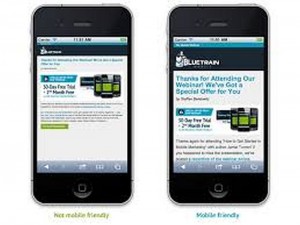
Mobile Friendly Emails
Most people check their emails using their Personal Computers, but many more use their smart phones several times a day along with their personal computers to keep up with their emails.
Many people check their emails on their Android or iPhone before they even get out of bed in the morning, and most will recheck their emails several more times during the morning and throughout the day. On an average day, a smart phone user will check their emails at least a couple of dozen times during a 24 hour period.
Needles to say, smart phone usage has sky rocketed and so has the growing number of people who use mobile devices to read their emails.
Well over 50% of all emails are opened on a mobile device of some sort, and for the past few years the number has been rising to well over 500%. You can bet the farm that in the future, the numbers will continue to rise.
The point is that you need to ensure that your emails are mobile friendly if you expect results.
So what constitutes a mobile friendly email?
Mobile friendly emails are simply emails that look great regardless of where they are read. They can be optimally displayed and look equally good on a desktop computer, a laptop, or on mobile devices. This means that regardless of where your potential customers reads your emails, they will be equally user friendly.
Ensuring that your emails are mobile friendly is not complicated, in fact it’s actually pretty easy if you heed the following suggestions.
Although the newer mobile devices are leaning towards larger sized screens, the reading area is still not comparable to that of a desktop or laptop computer. For this reason, it’s better to create emails using a single column template.
A multi column email template will have potential customers scrolling all over the place on a mobile device trying to read your message, even if they have one of the newer large screen phones. Multi column templates also cause problems with navigation of the content. Single column templates are generally much more flexible for all screen sizes and will make your emails much easier to read.
When designing mobile friendly emails, your message to potential customers should be clear and concise. This applies to all emails, but because of smaller screen sizes, it is especially important for emails that are read on mobile devices. Keep the design clean and simple. Your focus should be on only what is essential to get across your point.
Font and text size goes hand in hand with email design. Because of the relatively small screens in mobile devices, it is important that your text can be easily read. Avoid using tiny and odd ball fonts in your messages.
Use a 22pt text size for your headlines, and at least a 14pt font in the body of your message.
Another thing to consider when creating mobile friendly emails is contrast. To conserve battery life, many mobile phone users reduce the brightness level on their devices. In addition, with most mobile devices, it is usually extremely difficult reading an email outside in the daylight.
For this reason, strong contrasting text colors are recommended to ensure that your emails are mobile friendly. A black or extremely dark text on a white or very light background is the easiest to read in both of the scenarios above.
Images take time to load and take up valuable space. For this reason, use only images that are essential in getting your point across in your emails. One or two images per email is ideal for mobile devices and even then, your images may not be seen by potential consumers.
Android and many other mobile platforms turn off email images by default. So, you can’t always be sure that your images are being displayed properly in the recipient’s email. A recipient using the Android platform will initially see only boxes of white space where the image should be, unless you include the alt text of the image description. Then they will see the description of the image until they turn on “images”.
IPhone users don’t have this problem. The Apple Iphone operating system automatically enables email images by default.
Your email messages should be easily readable and look great regardless of whether or not images are displayed.
The last suggestion to ensure that your emails are mobile friendly should be included at the top of your email first; the clear call to action.
Be concise when including a call to action. Tell your reader what you want them to do and make it easy for them to do it. Don’t confuse things by including multiple calls to action in a mobile email.
If you want your reader to visit your web site, include the link in large button for them to click that is easy to find. If you want your reader to buy something now, include the link in a “Buy Here” button that is easy for them to find. Regardless of what action you want your reader to take, make it large, loud, and clear so there is no confusion. Mobile devices do not have a mouse, just the recipient’s finger, so make your call to action easy to find and to click.
To ensure that your emails are mobile friendly, give these simple suggestions a try.


